
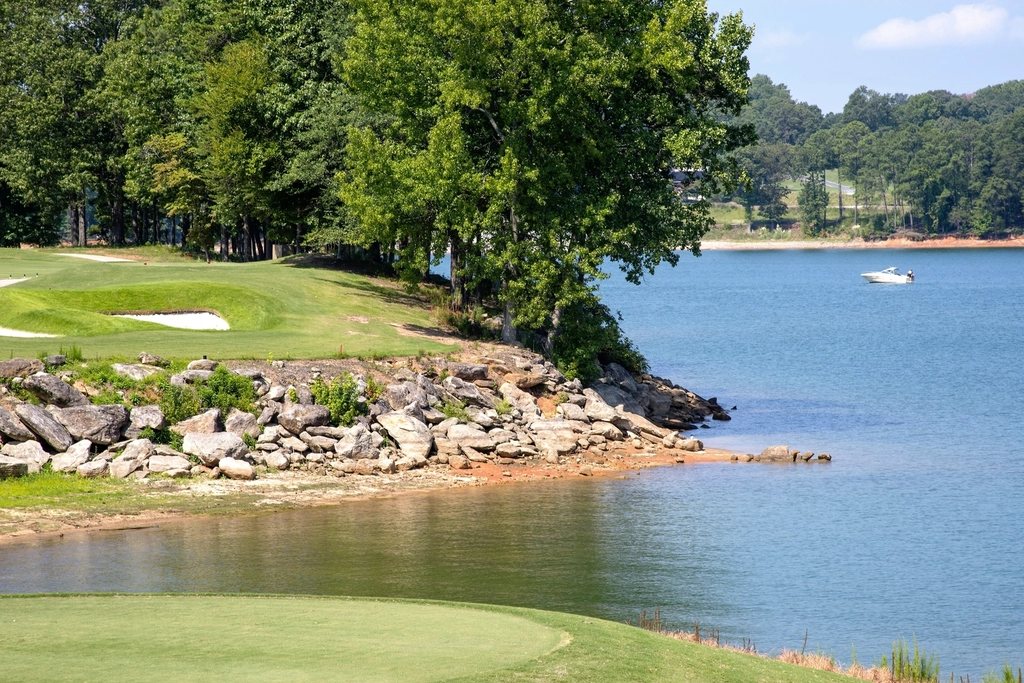
Golf has an awkward relationship with the environment, and both sides of the argument have a point. A course is a large piece of land, mowed, watered and fertilized so that a game can be played on it. That is a real cost. But the same course is also sixty hectares of unpaved ground in a region that is otherwise mostly subdivisions and parking lots, and what happens on that ground depends entirely on how it is managed. We think the honest position for a golfer is to understand both sides, and to notice the difference between a course that treats its land well and one that does not.
Table of Contents
How much of a course is actually golf
An eighteen-hole course typically occupies between fifty and seventy hectares, roughly seventy to a hundred football fields. The intensively managed part is smaller than most people imagine. Greens add up to about one hectare in total; tees about the same. Fairways, the widest stretches of short grass, cover perhaps twelve to fifteen hectares. Everything else, often half the property or more, is rough, trees, ponds, wetlands, creeks and the unplayed corners between holes.
That division matters because the environmental cost of a course is concentrated on the short grass and the environmental benefit is concentrated on everything else. Greens need the most water, the most fertilizer and the most attention. The out-of-play areas need almost nothing, and if they are left alone or deliberately naturalized they become the closest thing to a nature reserve that many suburbs have.
Courses as habitat
Ecologists who have surveyed courses find a consistent pattern. Where a course sits in farmland or in a city, it usually supports more bird species, more amphibians and more pollinating insects than the land around it, because it offers what those creatures lack elsewhere: a mix of open ground, tall grass, trees, standing water and edges between them. Where a course replaces a natural forest or wetland, the opposite is true. The question is always, compared with what.
The good news is that the trend at well-run courses has been in one direction for twenty years. Superintendents have been converting out-of-play rough to tall native grasses and wildflower meadows, which are mowed once a year instead of weekly, which cuts fuel and labour, and which fill up with grasshoppers, ground-nesting birds and butterflies. They leave dead trees standing for woodpeckers where they pose no risk. They put up nesting boxes for bluebirds and swallows, which in turn eat the insects that would otherwise be sprayed. They plant buffer strips of tall vegetation along ponds and streams, which keeps fertilizer out of the water and gives turtles and frogs somewhere to live. Anyone who walks a course at dawn knows how much wildlife is there: foxes, deer, herons, hawks, and in some parts of the country the occasional moose using the fairway as a highway.
The water question
Water is the hardest part of the argument. A course in a dry summer can use hundreds of thousands of litres a day, and in an arid climate several times that. In a country as wet as most of Canada this is less of a crisis than in the deserts of the American southwest, but it is still a lot of water taken from rivers, wells or a municipal system during the weeks when everyone else needs it too.
Better courses have cut their use sharply. Many now irrigate from their own ponds, filled by snowmelt and rain, rather than from the town supply. Some use treated wastewater. Modern irrigation systems control each sprinkler head separately, guided by soil sensors and weather data, so that a fairway is watered only where it is dry. Above all, the definition of a good playing surface has shifted. A generation ago a course was expected to be uniformly green from May to October. The best courses now accept, and even celebrate, a fairway that goes gold in August, because firm, dry turf is better to play golf on. The ball runs, the walk is easier, and the water bill is a fraction of what it was. The old Scottish links, unwatered and grazed brown, were the original model.
Chemicals, honestly
Courses use fertilizer, fungicides, herbicides and insecticides, and for a long time they used far too much of them. That has changed under pressure from regulators and from the people who work on the course every day. Several Canadian provinces have banned cosmetic pesticides on lawns while allowing golf courses to continue under conditions: courses must follow an integrated pest management program, in which chemicals are the last resort after mowing height, drainage, grass selection and tolerance of minor damage, and they must report what they apply and how much. In some provinces those reports are public, which is worth knowing when you choose where to play.
The practical result is that the most intensively treated part of a modern course is the greens, about one hectare, and the rough gets little or nothing. Fertilizer use has dropped as soil testing improved and as slow-release products replaced the old habit of feeding turf whether it needed it or not. Buffer strips and settling ponds catch most of what does run off. None of this makes a course a wilderness. It does make it a far lighter footprint than the same land under intensive agriculture, and comparable with or lighter than the same land as a subdivision of watered lawns.
What to look for, and what to ask
Golfers have more influence over this than we think, because courses respond to what their customers praise and complain about. A few signs of a course that takes its land seriously:
- Naturalized areas of tall grass and wildflowers between holes, with signs asking players not to search for balls in them.
- Unmowed vegetation along the banks of ponds and streams rather than turf running to the water’s edge.
- Fairways that are allowed to go firm and pale in a dry spell instead of being kept lush.
- Nesting boxes, standing dead trees and brush piles at the edges of the property.
- A published environmental plan or a certification from one of the recognized course-stewardship programs.
And a few things to do ourselves. Do not go looking for balls in the long grass during nesting season. Repair divots and pitch marks, which reduces the turf damage that gets treated with chemicals. Walk rather than ride where the course allows it, which spares the turf and the fuel. Say something at the desk when a course has done the right thing, and say something when it has not.
A golf course will never be a forest. But a well-run course is a large piece of open ground, kept open, with water and wild edges, in places where open ground is disappearing. Played the right way, the game gives its landscape as much as it takes, and a walk through one on a summer morning, with a hawk overhead and the rough alive with insects, is a fair argument for keeping it that way.