
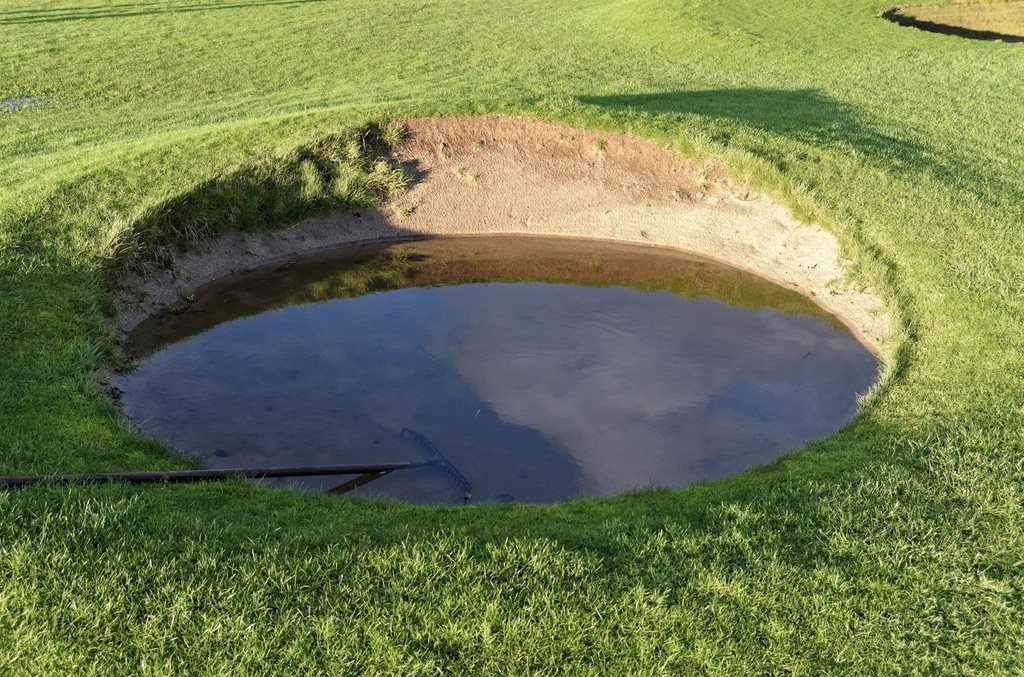
The official rules of golf run to well over a hundred pages, plus a book of clarifications, plus the local rules pinned to the noticeboard. No beginner needs all of that. In practice, a first season of golf involves the same half-dozen situations again and again: the ball we cannot find, the ball in the water, the ball in the sand, the ball we simply cannot hit, and the question of how to drop a ball without doing it wrong. The rules were rewritten in 2019 to be simpler and faster, and the versions below are the modern ones. If a playing partner tells you something different, they may be remembering the old book.
Table of Contents
The three-minute search
A ball is lost if it is not found within three minutes of starting to search. Not five, as it was before 2019; three, and the clock starts when you or your partners begin looking. If the ball is lost, or if it is out of bounds, which is marked by white stakes or a white line, the penalty is called stroke and distance: add one penalty stroke and play again from where you last played. On a tee shot, that means hitting your third from the tee.
The trouble with stroke and distance is the walk back, which is what makes it so unpopular and so slow. The answer is the provisional ball. If you think your ball may be lost or out of bounds, announce that you are playing a provisional, hit another from the same place, and walk forward. If you find the first ball in bounds, pick up the provisional and carry on with no penalty. If you do not, the provisional becomes your ball and you are already up the fairway, lying three. Saying the word “provisional” out loud matters; without it, the second ball is automatically the ball in play.
Many courses also adopt a local rule for casual play that avoids the walk entirely. Where it is in force, you may estimate where the ball was lost or crossed the boundary, drop a ball on the nearest edge of the fairway no closer to the hole, and add two penalty strokes. It costs one stroke more than stroke and distance, and it saves ten minutes.
How to drop a ball
Whenever you take relief, you drop, and the modern drop is easy. Stand upright, hold the ball at knee height and let it fall. It must land in and come to rest inside the relief area. If it rolls out, drop again; if it rolls out a second time, place it where it landed on the second drop. That is the whole procedure. The old shoulder-height drop is gone.
The relief area is measured in club-lengths, and a club-length means the longest club in your bag other than the putter, usually your driver. Free relief, from things such as cart paths, sprinkler heads, ground marked as under repair and puddles of temporary water, gives you one club-length from the nearest point of complete relief, no closer to the hole. Penalty relief, which we come to next, gives you two.
Water, now called penalty areas
Ponds, streams and ditches are marked with yellow or red stakes or lines, and the rules now call them penalty areas rather than water hazards. A red penalty area gives more options, and most courses mark nearly everything red these days. If your ball is in a penalty area and you can play it, you may: the old ban on grounding your club in a hazard is gone, and you can even move a loose twig or leaf first.
If you cannot play it, take one penalty stroke and choose. Option one, from any penalty area: play again from where you last played. Option two: keep the point where the ball last crossed the edge of the penalty area between you and the hole, go back as far as you like on that line, and drop within one club-length of the chosen spot. Option three, red areas only: drop within two club-lengths of the point where the ball last crossed the edge, no closer to the hole. Option three is the one nearly everyone uses. Work out where the ball crossed, not where it splashed, and pace out two driver-lengths from there.
Bunkers: what you can and cannot do
Sand causes more rule confusion than any other feature of the course, and most of it is out of date. Today you may touch the sand with your hand or club in most ways: leaning on a club, raking a footprint, moving a loose stone or leaf, even digging your feet in for a stance. You may not touch the sand directly in front of or behind the ball, take a practice swing that touches the sand, or deliberately test the surface. The point is that you may not improve the lie or learn about it by touching; everything else is allowed.
If the ball is plugged under a lip and you cannot play it, you can declare it unplayable, which we cover below, with one bunker-specific extra: for two penalty strokes instead of one, you may drop outside the bunker, keeping the ball’s position between you and the hole and going back as far as you want. For a beginner facing a wall of sand, that is often the sensible choice. And after you play, rake. The rules do not require it, but everyone behind you does.
The unplayable ball
You may declare any ball unplayable anywhere on the course except in a penalty area, and you are the only judge of whether it is. This is the rule that saves beginners from the deep woods and the base of the tree. Take one penalty stroke and choose one of three options: play again from where you last played; drop on the line back from the hole through the ball’s spot, as far back as you like; or drop within two club-lengths of the ball, no closer to the hole. Two club-lengths sideways is usually enough to get out from under a bush and back onto grass.
Small things that used to be penalties
Several everyday mishaps no longer cost anything. If you accidentally move your ball while looking for it, put it back without penalty. If you accidentally move it on the putting green, or knock your ball marker, replace it, no penalty. You may putt with the flagstick left in the hole. You may repair spike marks and other damage on the green. If your ball hits you or your equipment by accident, there is no penalty; play it as it lies. An embedded ball in the fairway or the rough may be lifted, cleaned and dropped free.
And the rule that covers everything else: when in doubt in a friendly round, play a second ball, finish the hole with both, and sort it out afterwards. The rules officially allow this in stroke play. Nobody minds, and it keeps the group moving, which is a rule of its own.