
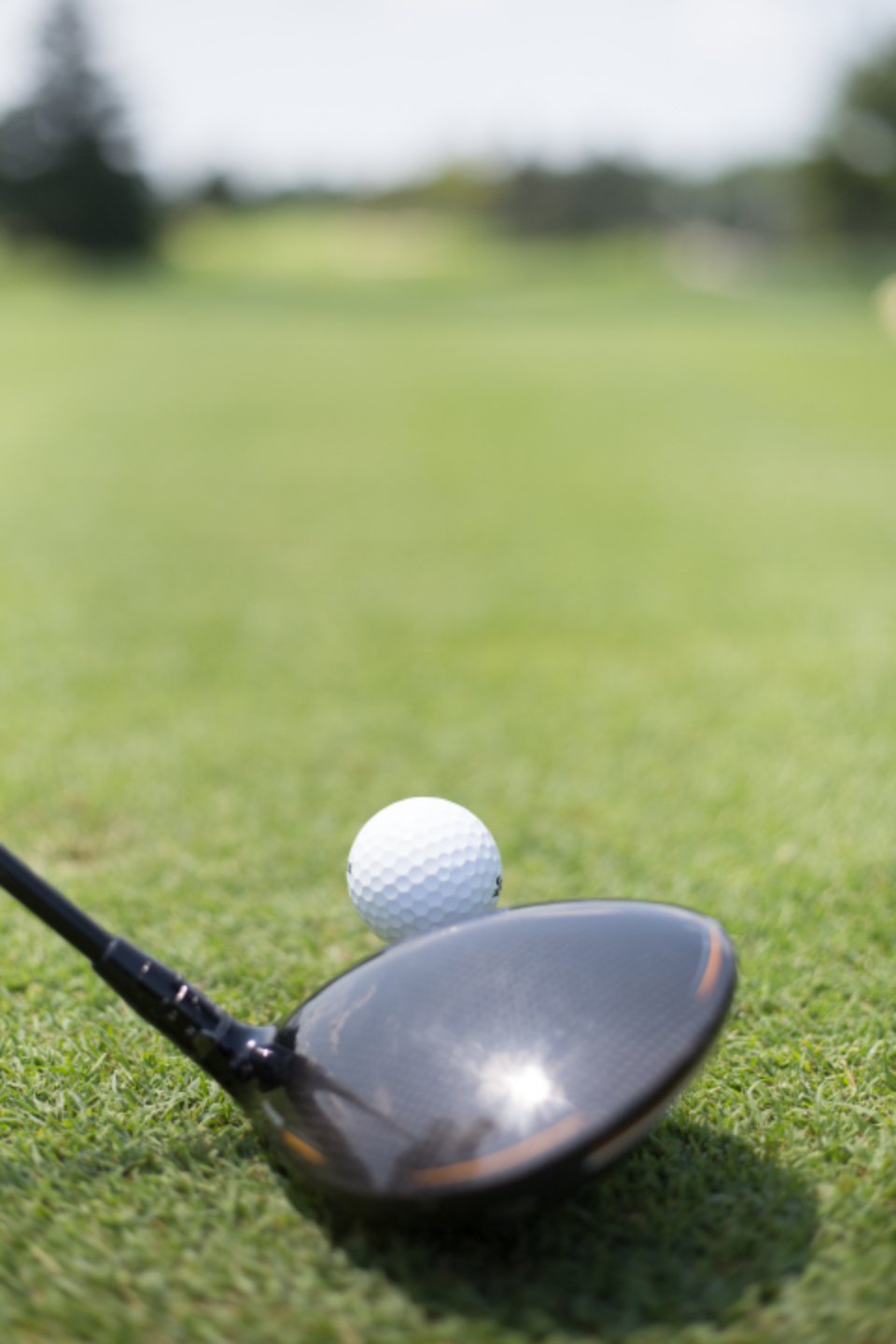
There is a moment every beginner knows. You have hit a dozen decent shots on the range, you walk to the first tee, you look up and see two players waiting behind you, and your mind fills with everything you have ever read about the golf swing. Keep the left arm straight. Turn the shoulders. Shift the weight. Do not sway. Hold the angle. Release the club. And then, with all of that swirling, you top the ball forty metres into the rough. This article is about what to do instead. It covers the two things that can be set up before the swing even begins, the grip and the stance, and then the single thought we would carry to the tee in place of all the others.
Table of Contents
Why the grip comes first
The grip is the only place where your body touches the club, so it decides where the clubface points at impact more than anything else you do. A poor grip is also the most common reason beginners slice, that curving shot that drifts weakly to the right for a right-handed player. Get the hands right and half the ugly shots in golf simply disappear.
For a right-handed player, start with the left hand. Let the arm hang naturally and place the club so that the grip runs diagonally from the base of the little finger across the middle of the index finger. It should sit more in the fingers than in the palm. Close the hand. Looking down, you should be able to see two knuckles of the left hand, sometimes two and a half. The V formed between thumb and forefinger should point roughly toward your right shoulder.
Now the right hand. It comes to the club from the side, with the club again sitting in the fingers, and the lifeline of the right palm folding over the left thumb. How you connect the two hands is a matter of comfort: the right little finger can overlap the left index finger, it can interlock with it, or all ten fingers can stay on the grip. None of these is wrong.
The pressure is the part beginners get wrong most often. Hold the club as if it were a small bird, or a tube of toothpaste with the cap off. Firm enough that it will not fly out, loose enough that your forearms are soft. Tension in the hands travels up the arms and into the shoulders and kills the swing before it starts.
The stance: a posture you could hold all afternoon
Good posture in golf looks like an athlete about to receive a serve, not a person bending to pick up a bag. Stand with your feet about shoulder width apart for a mid iron, a little wider for a driver, a little narrower for a wedge. Bend forward from the hips, not the waist, so your spine stays fairly straight and your backside moves behind you. Let your knees soften. Your arms should hang straight down from your shoulders, relaxed, with the hands a little in front of the body.
A quick test: if you let go of the club, it should fall on a line about a hand-width from your toes. If it lands on your shoes, you are standing too close; if it lands a foot away, you are reaching. Your weight should feel balanced across the middle of both feet, not on the toes and not back on the heels.
Ball position changes with the club. For a short iron or wedge, the ball sits roughly in the middle of the stance. For a mid iron, a ball-width forward of centre. For a driver, opposite the inside of the front heel, because the driver is meant to strike the ball slightly on the upswing. This one adjustment solves a great deal for beginners who cannot understand why the same swing hits a nine iron sweetly and a driver along the ground.
Alignment, the invisible fundamental
Most beginners aim to the right of their target without knowing it, because they line up their body at the flag rather than the clubface. The fix is a routine: stand behind the ball, pick a spot on the ground a metre in front of it on the line to the target, a leaf or a darker blade of grass, and aim the clubface at that spot. Then set your feet, hips and shoulders parallel to that line, like a railway track with the ball on the outer rail. It takes ten seconds and it is worth more than any change to the swing itself.
The one swing thought
Here is our proposal for the thought to carry to the first tee, and it is not about the arms or the wrists or the weight. It is this: turn and finish in balance.
Turn means that the shoulders rotate away from the target on the way back, so your back faces the target at the top, and then the body unwinds through the ball. Finish in balance means that at the end of the swing, your chest faces the target, nearly all your weight is on the front foot, and you could stand there and hold the pose while someone takes a photograph. That is it. If you turn and finish balanced, a great deal of the swing takes care of itself: the weight shifts because it has to, the club releases because the body pulls it through, and the tempo stays sane because you cannot swing violently and still stand still at the end.
Why one thought and not several? Because the golf swing takes about a second and a half from takeaway to finish, and the downswing itself takes less than a third of a second. There is no time to consult a list. The brain can hold one intention during a movement that fast. Choose it well and let the rest go.
Practising the setup without hitting a ball
The lovely thing about grip and stance is that they can be rehearsed at home, in the garage, in the hallway with a shortened club or even a broom handle. We would suggest a two-minute routine every evening for the first month:
- Take the grip, look at the knuckles and the V, then let go and take it again, ten times.
- Set up to an imaginary ball, check the hip hinge in a mirror or a window reflection, then stand up and do it again.
- Make five slow swings with no ball, holding the finish for a count of three each time.
By the time you reach a range, the setup will be automatic, and the only thing left to think about is the one thought.
What to expect on the tee itself
Even with all this, the first tee will produce some poor shots, and that is fine. Take the grip. Set the stance. Aim the face. Turn and finish in balance. Then walk after the ball, whatever it did, and do it again. The good ones, when they come, will feel like they arrived on their own.