
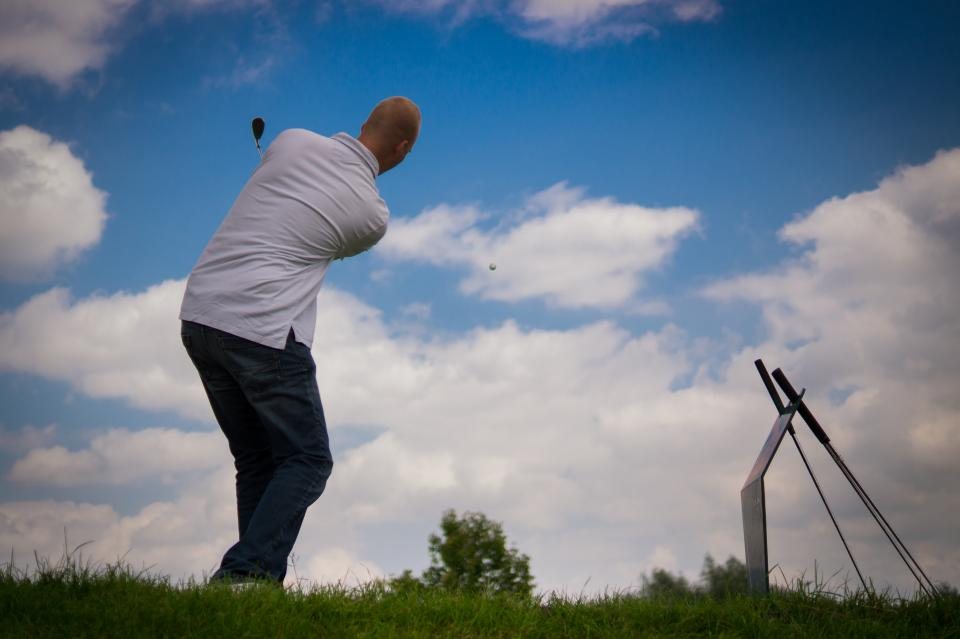
Most of us who come to golf as adults arrive with a small, private worry: everyone else seems to have started at eight years old, and we are starting at forty-two. The worry is understandable and almost entirely misplaced. Golf is one of the few sports where a beginner in their forties, fifties or sixties can reach a happy, competent level within a season or two, because the game rewards patience and rhythm far more than raw athleticism. What nobody tells you, though, is what the first ten hours actually feel like. So here it is, hour by hour, as honestly as we can put it.
Table of Contents
Hours one and two: the range, and the humbling
Almost everyone’s first contact with golf is a bucket of balls at a driving range. You will be handed, or will borrow, a seven iron (a mid-length club with a moderately angled face) and pointed at a mat or a strip of grass. Expect the first twenty swings to produce nothing much: a topped ball that skitters twenty metres, a swing that misses entirely, a shot that squirts sideways. This is not a sign of anything. It is simply what a body does when it meets a motion it has never made.
By the end of the second hour, most adults have hit two or three shots that fly properly, rising off the face and landing eighty or a hundred metres away (roughly ninety to a hundred and ten yards). Those two or three shots are the hook. They feel effortless, which is the whole mystery of golf in a single sensation: the good ones never feel like you tried.
Hours three to five: a lesson, and why it is worth the money
We would gently insist on at least one lesson with a teaching professional somewhere in the first five hours. Not because you cannot learn alone, but because the three things that matter most at the start, grip, posture and ball position, are nearly impossible to see in yourself. A coach will fix in five minutes what a video might leave you fighting for a year. Group beginner clinics, often run by public courses in spring, are the cheapest way to get this and have the added benefit of putting you beside other adults who are equally lost.
After a lesson, the range feels different. You will spend hours three to five hitting fewer balls and thinking more. This is normal, and it is a good sign. A bucket of sixty balls that takes forty minutes is far more useful than one that takes fifteen.
Hours six and seven: the short stuff
Here is a number worth remembering: in a typical round, more than half of all strokes are played from within fifty metres of the hole. Chips, pitches and putts. Most beginners spend their first ten hours hitting full shots and none of them on the practice green, then wonder why their scores are so high. So we would spend at least two of your first ten hours on the putting green and the chipping area, which are usually free to use at public courses.
Putting is also where an adult beginner can feel competent fastest. A ten-year-old has no advantage over you in rolling a ball three metres into a hole. It is a game of feel and attention, and adults are often better at both.
Hours eight to ten: the first time on grass that counts
Somewhere around hour eight, you should play actual holes. Not eighteen. Not even nine, necessarily. Many public courses have a short par-three layout, an executive nine, or quiet late-afternoon tee times when a beginner can play three or four holes without feeling watched. Pick the shortest tees. Pick up your ball when a hole is going badly. Nobody is counting, and the only score that matters in your first ten hours is whether you want to come back.
What surprises most adults on the course is not the difficulty of the shots but the walking and the thinking. A regulation eighteen-hole course is generally between five and six and a half kilometres from first tee to last green if you walk it directly, and closer to eight kilometres with the wandering a beginner does. Nine holes is a comfortable hour and a half to two hours on foot. You will be tired in a way the range never made you tired, and that is part of why the game is good for us.
What you actually need to buy, and what you do not
The equipment industry would like you to spend a great deal in your first ten hours. Resist it. Here is our honest list:
- A half set of clubs, second-hand is perfectly fine: a driver or a fairway wood, a hybrid, a seven iron, a nine iron, a pitching wedge, a sand wedge and a putter. Seven or eight clubs, not fourteen.
- A carry bag with a stand, light enough to walk with.
- A dozen inexpensive balls. You will lose several of them, and that is the point of buying cheap ones.
- A glove for your top hand (left hand for a right-handed player), which stops blisters during the range phase.
- Shoes with some grip. Proper golf shoes are nice but running shoes with a decent tread will do for the first month, provided the course allows them.
Everything else, the rangefinder, the training aids, the expensive ball, can wait until you know you love the game.
The honest timeline after hour ten
At ten hours in, a typical adult can hit a seven iron in the air more often than not, roll a putt with reasonable pace and get around a few short holes without embarrassment. That is real progress. What comes next is slower and less linear. Expect a plateau around month two, a breakthrough that arrives on a random Tuesday, then another plateau. Expect that you will play a great nine holes and follow it with a terrible one. That inconsistency is not a flaw in you; it is the nature of the game, and it is the same for players who have been at it for thirty years.
The one thing we would ask of any adult beginner is to protect the fun. Play with friends who are learning too, or with generous friends who already play. Walk when you can. Notice the light on the fairway at seven in the evening in July. Golf played outdoors, at a comfortable pace, with people we like, is one of the great pleasures available to an adult body. Ten hours is enough to find out whether it is for you. For most of us, it turns out that it is.