
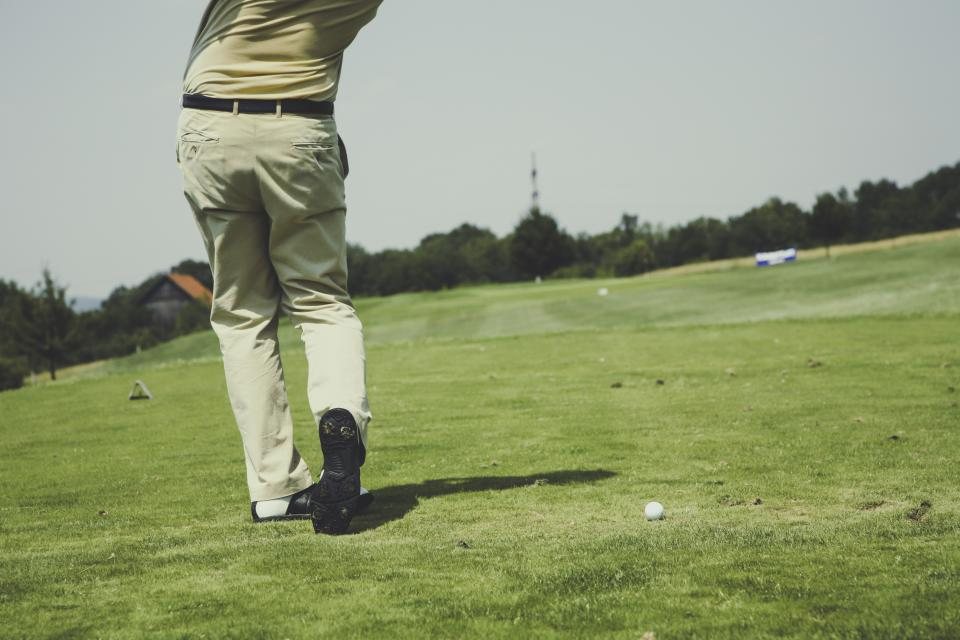
Most of us take up golf as adults, and most of us bring an adult’s body to it: a back that has spent twenty years at a desk, hips that have forgotten how to rotate, and a swing borrowed from a video. Then we wonder why the lower back complains on the tenth tee. The golf swing is a fast, one-sided twist repeated forty or fifty times a round and many more on the practice range. The body can handle that beautifully, but only when the twist happens in the right places. This is a practical guide to where it should happen, and a routine short enough that you will actually do it.
Table of Contents
Where the rotation should come from
A full swing turns the shoulders roughly 90 degrees and the hips roughly 45 degrees on the backswing, then unwinds both far faster on the way down. That rotation has to be supplied by joints designed to rotate: the hips, and the middle part of the spine between the shoulder blades, called the thoracic spine. The lower back, the lumbar spine, is built for bending forward and back and for stability; it rotates only a few degrees at each level, and it does not like being asked for more.
When hips and thoracic spine are stiff, the swing still finds its 90 degrees. It borrows the missing rotation from the lumbar spine and from the knees, which is how a game played at walking pace produces the same back and knee complaints as sports with far more running. The fix is not to swing shorter. It is to give the swing the mobility it needs where it needs it.
The hips: the joint golf lives on
Stand up and try to turn your pelvis while keeping your feet planted. Hip internal rotation, the movement that lets the lead hip clear out of the way on the downswing, is the single mobility measure most closely linked to back trouble in golfers, and it is the one that desk life takes away fastest. Sitting shortens the front of the hip and switches off the muscles at the back of it, so the pelvis stops moving and the spine takes over.
The good news is that hips respond quickly to a few minutes of daily attention. The moves below are ordinary, unglamorous and effective.
The ten minutes
Do these in order, before you play or on any day you are not playing.
- Cat and cow, one minute. On hands and knees, round the back toward the ceiling, then let it sag toward the floor. This wakes up the whole spine and tells the lumbar area it is allowed to move a little, rather than lock.
- Open book, one minute each side. Lie on your side with knees bent at 90 degrees and arms stacked in front. Lift the top arm and open it across your body toward the floor behind you, letting the chest follow while the knees stay together. This is thoracic rotation in its purest form.
- Ninety-ninety hip switches, two minutes. Sit on the floor with one leg bent in front and one bent to the side, both knees at right angles. Rotate the knees together to the other side without using your hands.
- Hip hinge with a club, one minute. Hold a club along your spine so it touches the back of your head, the upper back and the tailbone. Push the hips back and fold forward, keeping all three contact points. This teaches the posture you set up in and trains the hamstrings and glutes to hold it.
- Glute bridges, one minute. Lie on your back, knees bent, and lift the hips until the body forms a straight line from shoulders to knees. Squeeze at the top. The glutes power the downswing and, when they are asleep, the lower back does their job.
- Split squats, one minute each side. Step one foot forward and lower the back knee toward the ground, keeping the front shin upright. This stretches the front of the back hip and strengthens the front leg for the shift of weight through the ball.
- Standing rotations with a club, one minute. In your golf posture, hold a club across the shoulders and turn back and through, letting the hips lead. Start at half speed and finish at something close to swing tempo. This is the bridge between the floor and the first tee.
What a warm-up on the day should look like
The routine above is a warm-up as much as a fitness plan, and it matters most on the day you play. Golfers who go straight from the car to the first tee are asking cold tissues to do their fastest work of the day. Muscle and tendon become more elastic as they warm, and a gentle rise in heart rate over ten minutes reduces the chance of the small strains that turn into weeks off. If you have time, follow the floor work with twenty or thirty easy swings on the range, starting with a wedge and working up to the driver. If you do not have a range, swing two clubs together slowly a dozen times behind the first tee.
The other habit that protects backs is the one nobody talks about: how you pick things up. Bend at the hips and knees to lift the bag, to tee the ball, to take it out of the cup. A round involves forty or more of those bends, and doing them with a rounded lumbar spine adds up over a season.
Strength for the long run
Mobility lets the swing happen in the right places; strength lets it happen there for a long time. You do not need a gym. Twice a week, add a few sets of the split squats and bridges above, plus a plank held for thirty seconds to a minute, and a carry: walk fifty metres holding something heavy in one hand, then switch. The plank trains the trunk to stay stable while the limbs move, which is precisely the golf swing’s demand. The one-sided carry trains the muscles along the side of the trunk that keep the pelvis level when you walk with a bag on your shoulder or push a cart uphill.
Golfers past fifty should add balance work, as simple as standing on one foot while brushing your teeth. Balance drives the ability to shift weight to the lead side at impact, and it is the ability that declines earliest without practice.
When to stop and ask
General advice like this is meant for a healthy back that is simply stiff. Pain that shoots down a leg, numbness, pain that wakes you at night or that follows a specific injury deserves a visit to a health professional before you keep swinging. A physiotherapist who understands the golf swing can look at your hips and thoracic spine directly and tell you which of these movements you actually need. For the rest of us, ten minutes a day is a small price for a back that is still willing to play in November.