
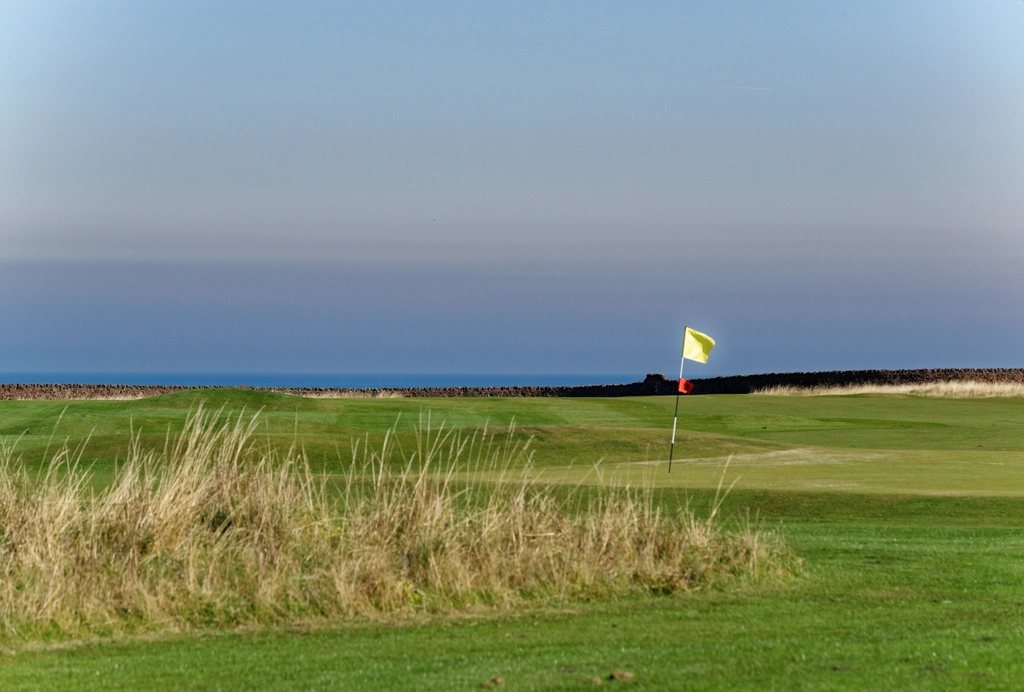
Golf began beside the sea, on the sandy strips between Scottish beaches and farmland, and something in the game still feels most like itself when there is salt in the air. Canada has two long coastlines with very different golf on them. In the east, the Maritimes offer dunes, cliffs and Atlantic wind. In the west, Vancouver Island and the mainland coast offer rain-forest courses that stay green all year and afternoons when the sea breeze turns a simple par 4 into a puzzle. This article is about what makes coastal golf different, how to play in wind for the first time, and where the seaside courses are.
Table of Contents
What “links” actually means
The word gets used loosely, so it is worth being precise. True linksland is the sandy, undulating ground that links the beach to the fields behind it. It drains quickly, grows fine fescue and bent grasses, and has few trees because nothing much grows in sand and wind. The turf is firm, the ball bounces and rolls, and the natural hollows became the first bunkers. A links course is one built on that ground. A course beside the sea on clay soil with trees and soft fairways is a coastal course, and a pleasant one, but it is not links. Canada has only a handful of courses on real linksland, most of them on the west coast of Cape Breton around Inverness, where the old coal-mining shore turned out to be sand dunes.
On firm turf the game changes. A shot that lands ten metres short of a green may run onto it. A shot that lands on the green may run through it. The low running approach, the bump and run, becomes a real option rather than a trick, and the putter is useful from well off the green.
Playing in wind for the first time
Wind is the defining feature of seaside golf, and there is no way to learn it except by standing in it. A few principles help. Into the wind, take more club and swing easier; a hard swing puts more spin on the ball and the wind grabs spinning balls and lifts them up and back. A steady 25 km/h headwind, which is a normal afternoon on the coast, can take two clubs off a full shot. The same wind behind you gives back only about one club, because the ball flies lower and lands sooner than you expect. In a crosswind, aim into the wind and let it bring the ball back, rather than trying to fight it with a curve.
Keep the ball low when you can. Put it back in your stance, shorten the swing, and chase it along the ground. The high, floating wedge you learned on a calm inland range is the worst shot on a windy links; a firm seven iron that never gets above head height is the best. And remember that wind affects putting too: a strong gust will move a ball on a fast green, and it will certainly move you, so widen your stance.
Sea-level air is the densest air you will ever play in. If you have been reading about how far the ball flies in the mountains, expect the opposite here: your normal distances, and then a little less.
The Maritimes
Cape Breton is the heart of Atlantic golf. On the island’s northeast shore, the course at Ingonish inside Cape Breton Highlands National Park is a public course run by the park, laid out in the 1930s through a river valley that opens to the ocean, and it is a walk of nearly ten kilometres. On the west coast, the dunes at Inverness hold the closest thing to Scottish links in North America. Prince Edward Island has more than two dozen courses for a population of 175,000, many of them along the red sand of the north shore near Cavendish and along the eastern coast near Brudenell, with a season that runs from early May to late October. New Brunswick’s Fundy shore has a nine-hole course inside Fundy National Park where the tide below rises and falls by up to 12 metres, twice a day. Newfoundland’s courses are few and wind-blasted and open only from June.
Weather on the Atlantic coast means fog in the mornings in June and early July, clearing by ten, and a wind that builds through the afternoon. September and early October are the best weeks: warm water, steady weather and empty fairways.
The West Coast
Vancouver Island and the Lower Mainland have Canada’s only true year-round golf. Victoria, at the southern tip of the island, is the mildest city in the country, with an average January high near seven degrees, and its public courses close only for the rare snowfall. The trade-off is rain: from November to March, expect soft fairways, a ball that plugs, and waterproof shoes as standard equipment. Farther up the island, the course at Tofino is a nine-holer in the rain forest with the Pacific a short walk away, and the courses along the Sunshine Coast and up Howe Sound play beside water framed by mountains. The sea breeze here follows a pattern: calm mornings, wind rising from the water after noon as the land heats up, so an early tee time is a calm one.
The turf is different from the east. West coast fairways are soft and green even in August, the rough is lush, and the game is more in the air than on the ground. It is coastal golf, not links golf, and it is beautiful.
What to pack for a seaside round
- A windproof layer and a waterproof one; the two are not the same thing.
- A cap with a strap or a beanie, because a loose hat lasts one hole.
- Waterproof shoes and a second glove kept dry in a bag.
- Low-numbered irons and a hybrid for running shots; leave the high lob wedge in the trunk.
- Sunscreen even under cloud; reflected light off the water burns.
The walk is the point
A seaside round is an eight-to-ten-kilometre walk beside the ocean with something to think about at every step. Your score will probably be a few strokes worse than at home, at least the first time, and it does not matter. Play the ball along the ground, lean into the wind, look up between shots, and understand why the people who invented this game put it where they did.