
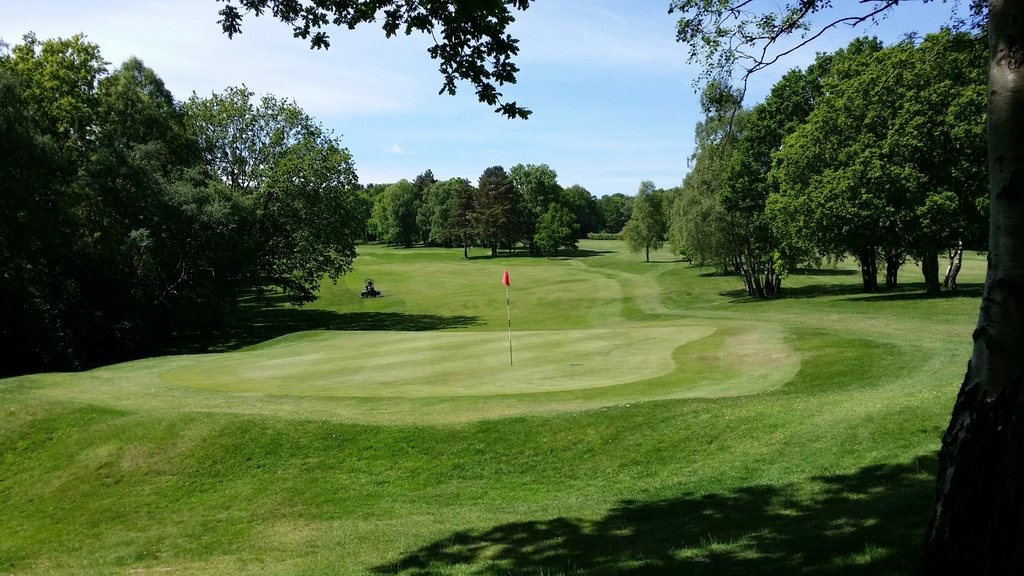
The range is a laboratory. The course is the real thing, with wind, slopes, long grass, ponds that seem to attract balls, and the small but real pressure of other people playing behind you. Sooner or later every beginner has to make the leap, and our advice is to make it sooner. Nine holes is the right size for a first round: long enough to feel like golf, short enough to finish with energy and goodwill intact. Here is how we would plan it.
Table of Contents
Choosing the right course
Not all courses are equally kind to a first round, and the difference matters more than any lesson. Look for a public course with a nine-hole option, ideally a shorter layout. Executive courses, which mix par threes with a few short par fours, are perfect. So are dedicated par-three courses, where every hole is between about 80 and 200 metres (90 to 220 yards) and a beginner can reach the green with one reasonable shot and one lucky one. Many municipal courses across Canada offer these, and they tend to be relaxed places where nobody minds a topped tee shot.
Timing matters too. Late afternoon on a weekday is quiet; Saturday morning is not. Twilight rates, which usually begin a few hours before sunset, are cheaper and the course empties out. A first nine holes played at six in the evening in June, when the light in most of Canada lasts until well past nine, is a very different experience from one played at nine on a Saturday morning behind a foursome of regulars.
Whatever course you choose, play from the forward tees, whichever colour they are. There is no honour in playing a course longer than your game, and shorter tees turn a lost cause into a hole you can actually finish.
What to bring, and what to leave in the car
Here is the whole kit, and it fits in a light carry bag:
- Seven or eight clubs: a wood or hybrid for long shots, a couple of mid irons, a short iron, a pitching wedge, a sand wedge and a putter. A full set of fourteen is heavier and no more useful to a beginner.
- Eight to ten balls. You may lose half of them and that is fine.
- A dozen tees, a ball marker (a coin works), a pitch-mark repair tool and a pencil.
- A glove for the top hand, and a second one if it is hot.
- A bottle of water and something to eat. Nine holes on foot is between two and a half and four kilometres of walking, and beginners are often surprised by how hungry they get.
- Sunscreen, a hat and a light layer for wind. A course is an open field, and it is always windier and sunnier than the parking lot.
Leave the rangefinder, the extra clubs and the fifty-dollar box of premium balls at home. Most courses mark distances on sprinkler heads or small posts along the fairway, usually to the centre of the green, in yards in Canada. Use those.
The first tee, honestly
Nerves on the first tee are universal and they never entirely go away, even for players with decades of experience. Two things help. First, arrive early enough to hit a few putts and a few chips, so your hands have touched a club before the first swing that counts. Second, do not use the driver. Take the club you hit best on the range, often a seven iron or a hybrid, and simply put the ball in play. A 120-metre shot down the middle is a fine start to anyone’s golfing life.
Pace: the one etiquette rule that matters
Beginners worry about a hundred rules and only one really matters on a first round: keep up. Not because you must play well, but because the group behind you would like to finish before dark. Keeping up is not the same as rushing. It means being ready to hit when it is your turn, walking briskly between shots, and taking no more than two or three practice swings.
It also means knowing when to pick up. If you have hit eight strokes on a hole and are still fifty metres from the green, pick up the ball, walk to the green and putt out with everyone else. Nobody will think less of you. In fact the players behind you will think considerably more of you. A relaxed nine holes for a group of three or four should take around two hours, perhaps two and a quarter. If you are well behind the group ahead and the group behind is waiting, wave them through at the next tee and let them play past. It is a small courtesy that instantly makes the rest of your round more enjoyable.
Keeping score, or not
We would suggest not keeping a strict score for the first few rounds. Instead, count the good shots. Or keep a simpler score: how many holes did you finish, and on how many did you take a bounded number of strokes, say no more than double par? A par four played in eight strokes is, for a beginner, a perfectly respectable result and a sign that the ball is generally going forward. When you do start keeping score properly, a beginner playing nine holes on an executive course might expect something between 50 and 65, and that is nothing to be discouraged by. The scorecard will make more sense after a few rounds, and we cover reading it elsewhere in this magazine.
Making it fun, which is the actual point
The single biggest predictor of whether an adult sticks with golf is not talent. It is whether the first few rounds were enjoyable. So we would build fun into the plan deliberately. Play with one or two friends who are also starting, so nobody feels like the weak link. Or play with a generous friend who already plays and who is happy to pick the club for you and laugh at the bad ones alongside you. Agree in advance that lost balls are not a tragedy and that anyone may pick up at any time.
Notice the course itself. Nine holes on foot is a walk through a landscape that has been shaped and kept for the pleasure of walking through it: the smell of cut grass, a hawk over the trees behind the fourth green, the pond that catches the low sun on the way back to the clubhouse. Golf is a game played outside, in the weather, and the fresh air and the walk are worth something regardless of the score.
And when it is over, go into the clubhouse or sit on the bench by the ninth green and talk about the two or three shots that went right. There will be two or three. There always are. They are the reason people come back for a hundred more rounds, and they will be the reason you do too.
You made some decent points there. I looked on the web for the issue and found most people will go along with together with your website.
I am constantly looking online for posts that can assist me. Thank you!