
The scorecard is the least glamorous object in golf and one of the most useful. Folded into a back pocket, it carries a small map of the course, the length of every hole from every set of tees, a ranking of the holes by difficulty, two mysterious numbers that describe the whole course, and the local rules on the back. Most beginners use it only to write down a number after each hole and never look at the rest. This piece is a slow walk through everything printed on it, so that the next time you pick one up at the starter’s hut, it reads like a plan rather than a spreadsheet.
Table of Contents
The columns: hole, tees and par
Read the card from left to right. The first column numbers the holes one to eighteen, with a subtotal after nine labelled Out and another after eighteen labelled In, a leftover from the old links courses where the first nine went out along the coast and the second nine came back.
Next come several rows of distances, one per set of tees, each named by a colour. The longest set, often black or gold, is for very strong players; the shortest, often red or a similar colour, is the forward set. Nothing on the card says who must play which. A sensible rule of thumb is to add up the total yardage and choose tees where the course measures between 4,500 and 5,500 yards for a beginner, which is roughly 4,100 to 5,000 metres. On a good many Canadian courses, that is the forward or second-forward set.
Distances on the card in Canada are almost always in yards, measured to the centre of the green along the intended line of play, not in a straight line. One yard is 0.914 metres, so a 400-yard hole is about 366 metres.
Then comes par: the number of strokes a skilled player is expected to need on the hole. Par is set mostly by length. For men, a par three is generally up to about 260 yards, a par four from about 240 to 490, a par five from about 450 up; for women the bands sit lower. A regulation course adds up to a par of 70 to 72.
The handicap column, which is not your handicap
A column headed Handicap or HCP or Stroke Index puzzles nearly everyone at first. It does not refer to your personal handicap. It ranks the eighteen holes from 1 to 18 by difficulty, with 1 the hardest and 18 the easiest, according to how much harder each hole plays for an average golfer than for a scratch golfer. Odd numbers are usually assigned to one nine and even numbers to the other, so that the difficulty is spread across the round.
The column exists to distribute strokes in handicap competition. If your playing handicap gives you 12 strokes, you receive one extra stroke on each of the twelve holes ranked 1 to 12 in that column. With 20 strokes, you get one on every hole and a second on the holes ranked 1 and 2. It is the quiet genius of golf: the same card lets a beginner and an expert compete on the same afternoon with a real chance of either winning.
Course rating and slope: the two little numbers
Beside each set of tees you will find two numbers, something like 70.4 and 128. The first is the course rating, the score a scratch golfer would be expected to shoot from those tees on a normal day. The second is the slope rating, a measure of how much harder the course plays for an average golfer than for a scratch golfer. Slope runs from 55 to 155, and 113 is defined as standard difficulty. A course with a slope of 135 punishes a beginner’s misses much more than one at 110: the rough is deeper, the water is closer, the greens are more heavily guarded.
Under the handicap system used in Canada and most of the world, your handicap index is adjusted by the slope of the tees you play, so that a 24 index becomes a slightly different number of strokes on a hard course than on an easy one. For a beginner choosing where to play, the practical lesson is this: when two courses are the same length, pick the one with the lower slope. It will be a kinder day.
The course map and the markers on the ground
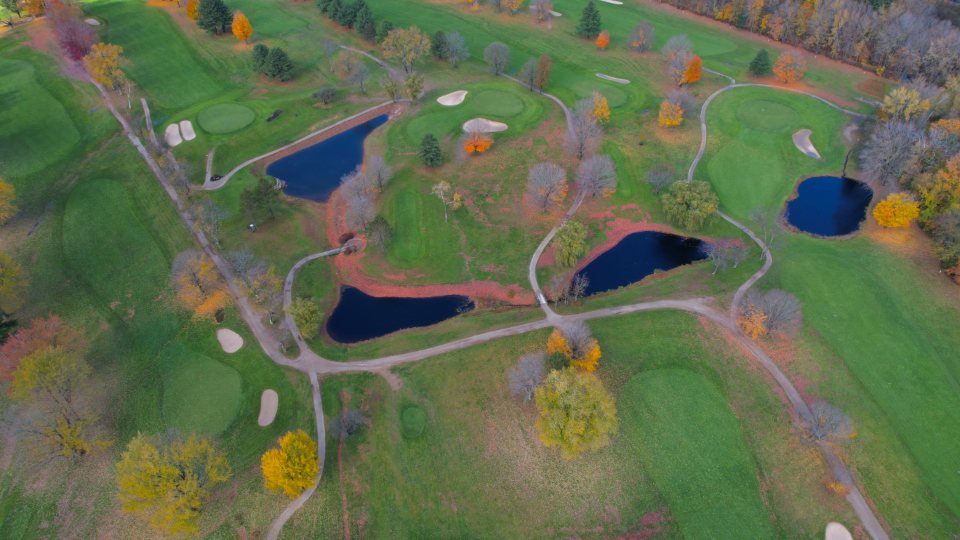
Most cards fold out to a small map of each hole. Read it before the tee shot. It usually shows the shape of the fairway, the position of bunkers and water, and a few distances: from the tee to a bunker, from the tee to the far edge of a pond, and to the centre of the green. It is worth knowing where the trouble starts so you can aim away from it.
Out on the course, the map is supported by markers. A few of the common ones:
- Coloured posts or discs beside the fairway, typically at 200, 150 and 100 yards from the centre of the green; the 150 marker is often a white post or a small tree.
- Distances printed on sprinkler heads, usually to the centre of the green.
- Red stakes or lines mark a penalty area from which you may drop nearby for one stroke; yellow stakes mark a penalty area with slightly fewer drop options.
- White stakes or lines mark out of bounds, where the ball must be replayed from the original spot with a one-stroke penalty, unless the course posts a local rule allowing a drop.
The back of the card: local rules and pace
Turn the card over and you will find the course’s local rules. These vary and they matter: whether a beginner may drop a ball on the fairway edge for an out-of-bounds shot instead of walking back, how to treat a flooded bunker, whether a cart path or a young tree is treated as an obstruction you can take relief from. There is often a pace-of-play guideline, such as four hours and fifteen minutes for eighteen holes. Reading it takes two minutes and saves an argument on the eleventh tee.
Filling in your own numbers
Finally, the part everyone already knows: writing down the score. Write the total strokes for each hole, including any penalty strokes, in the row with your name. Add the nine-hole subtotals and the total at the end. For a beginner, we would suggest one small refinement. Cap any hole at double par, so an eight on a par four becomes an eight and a disaster on a par five stops at ten. It keeps a bad hole from wrecking the card, it is close to how handicap scoring treats blow-up holes anyway, and it makes the number at the bottom something you can actually track from week to week. A scorecard is not a judgment. It is a record of a walk, and, once you know how to read it, a very good map.