
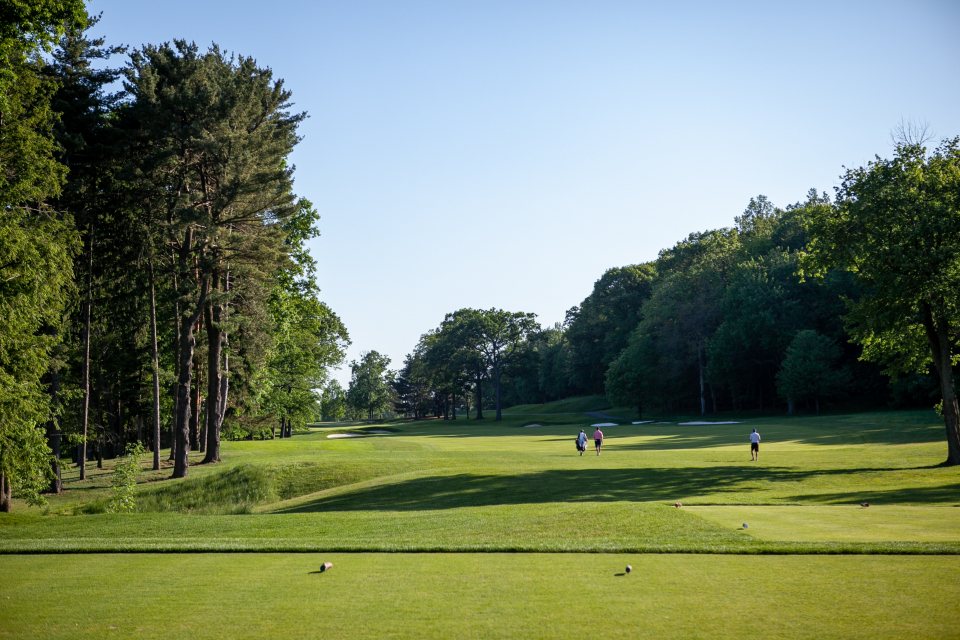
One of the quiet surprises for anyone taking up golf as an adult in Canada is how much of the game is open to everyone. Of the roughly 2,300 courses in the country, the large majority are public in one way or another. You do not need a membership, a sponsor or a letter of introduction. You need a tee time, a set of clubs and a willingness to walk. This article explains the different kinds of public course, how the booking systems usually work, what a scorecard is actually telling you, and how we go about finding a good one in a town we have never played.
Table of Contents
Municipal, daily-fee, semi-private: what the words mean
A municipal course is owned by a city, a town or a park board and run as a public service, much like an arena or a pool. Vancouver, Edmonton, Calgary, Winnipeg, Toronto and Montreal all operate them, and many smaller municipalities own a nine-hole course near the edge of town. A river-valley course in Edmonton has been played since the 1890s and is often described as the oldest municipal course in the country. Prices are set by council, residents often get a discount or an earlier booking window, and the atmosphere is about as unpretentious as golf gets.
A daily-fee course is privately owned but open to anyone who pays the green fee. This is the largest category in Canada and it runs from a farmer’s family nine-holer to championship layouts with a full practice range. A semi-private course sells memberships but keeps a share of its tee times for the public, sometimes only on certain days or after a certain hour. When a semi-private course lists “public welcome”, it usually means the afternoon and the shoulder months rather than Saturday at 8 a.m.
Then there are the short courses: par-3 layouts where no hole is longer than about 200 metres, executive courses that mix par 3s and short par 4s, and pitch-and-putt courses with holes of 50 to 100 metres. These are the best places in the country to learn, and we think adult beginners overlook them far too often.
How booking usually works
Almost every public course in Canada now takes reservations online. The typical booking window opens seven days in advance, sometimes fourteen, and municipal systems frequently give residents a head start of a day or two. Popular weekend mornings go within minutes of the window opening, so if you want an early Saturday time in July, set an alarm. Weekday afternoons and evenings, by contrast, are rarely full outside the biggest cities.
Most systems let you book as a single, a twosome, a threesome or a foursome. If you book as a single, expect to be paired with strangers. This is normal and, in our experience, one of the pleasures of public golf: you meet the retired machinist who plays every Tuesday and the teenager who just broke 90 for the first time. Twilight rates start in the late afternoon and are often half the daytime fee, which for a beginner in summer means nine or ten holes of long shadows and an empty course.
Walking is allowed nearly everywhere in Canada, and on most municipal courses it is the norm. A power cart is an extra charge. A pull cart or push cart is usually a few dollars to rent, or you can bring your own.
Reading the scorecard before you go
A scorecard has more information than most beginners realise. Each set of tees has a total length. A full-length course from the back tees is around 6,000 to 6,500 metres (6,500 to 7,100 yards); the forward tees on the same course might be 4,500 metres. Pick the set that matches your driving distance, not your pride. A useful rule: if your typical drive goes 180 metres, play tees around 5,000 metres or shorter and you will hit far more greens in regulation.
Course rating tells you what a scratch player would be expected to score from those tees. Slope, a number between 55 and 155, tells you how much harder the course gets for an average player relative to a scratch player. A slope of 113 is the standard. Anything above 130 means forced carries, thick rough or water hazards that will punish a mishit, and as a returning player we would avoid those until our game settles.
The walk itself is worth knowing. Eighteen holes with a total length of 5,500 metres adds up to about eight to ten kilometres once you include the walks between greens and tees and the detours into the trees. Nine holes is a comfortable four to five kilometres and about two hours.
Finding a good one in an unfamiliar town
We start with a map rather than a review. Where is the course? A layout in a river valley, on old farmland or along a lakeshore will usually have more character than one wedged between subdivisions. Next we look at the length from the middle tees and the slope. Then we check what the course says about itself: walking-friendly, nine-hole rate, twilight rate, a practice green and a range. A public course that is proud of its practice green is a course that cares about beginners.
The things that make a public course genuinely good are mostly about maintenance and pace. Greens that roll true, fairways that are mowed, bunkers with actual sand, tee boxes that are level. On pace, a course that posts a target time and has a marshal on a busy day is doing you a favour. Look at the photographs with a skeptical eye. A drone shot at sunset flatters everything; a photograph of the tenth green in mid-July tells you more.
A short checklist for your first public round
- Book a weekday afternoon or twilight time for your first few rounds; the course will be quieter and nobody will be behind you.
- Choose the forward or middle tees. Nobody at a public course cares which markers you play from.
- Bring a pull cart, a dozen balls you do not mind losing, and water.
- Ask at the counter whether nine holes is an option; many courses sell it.
- Arrive thirty minutes early, putt for ten of them, and be on the tee five minutes before your time.
Why municipal golf matters
It is easy to think of golf as an expensive sport, and it can be. But the municipal course down the road, with its cracked parking lot and its friendly starter, is where most Canadian golfers actually learned the game. It is where a beginner can play nine holes on a Wednesday evening for the price of a movie, walk five kilometres, hit a few good shots and a lot of poor ones, and come back the following week. If your town has one, use it. If it does not, the daily-fee course in the next town will be glad to see you. The game belongs to the people who play it, and in this country the door is wide open.