
Most golfers who walk a full round cover somewhere between five and seven miles, which is roughly eight to eleven kilometres. That distance is well beyond what the scorecard suggests, and it adds up to more than 10,000 steps. The reasons for the gap, and what it means for your legs and your day, are easier to plan around once you see where the extra ground comes from.
Table of Contents
Why does a round cover more ground than the course length?
A source from an orthopedic practice puts the tee-to-green distance of an 18-hole course at about 4 to 5 miles. Once you add the walk from each green to the next tee, the detours to find a ball and the zigzag between where your shots finish, most golfers end up covering 5 to 7 miles.
This explains why two players on the same course can finish with different totals. Each swing that sends the ball off the centre line adds steps, and a player who sprays shots wide will walk more than a player who keeps the ball in the fairway. Layout matters in the same way: where a green sits in relation to the next tee decides whether the walk between holes is a few paces or a long trek.
It helps to think of the number as a range rather than a fixed figure. One writer who tracked his rounds with a phone at his home course reported an average of about 6 miles. Treat that as a reasonable middle point, and expect your own figure to shift with the course and with how you play it.
How many steps and how much effort is that?
One source states that golfers exceed 10,000 steps during a typical round regardless of handicap, sex or course played. Another gives a wider estimate of 10,000 to 15,000 steps or more. The honest reading is that a walked round usually lands above the common daily step target, with the upper end reserved for longer or more spread-out courses.
Calorie figures vary a great deal between sources, which is a good reason to treat them with caution. One writer cites estimates of roughly 700 to 1,500 calories for a round, while the orthopedic practice offers a range of 1,000 to 2,000 depending on age, weight and terrain. The spread is wide because body size, pace and whether you carry your clubs all change the result. Use these as rough bounds, not as a number to log precisely.
One comparison puts a walked round on par with a run of about 3.5 to 4 miles, because walking is mechanically more efficient than running. What sets golf apart is how the effort arrives: a steady, moderate load spread over several hours rather than a short hard session. That is easier on the body for many people, and it is also why fatigue shows up late in a round rather than early.
How do terrain and your bag change the walk?
Hills do not necessarily add distance to the card, but they raise the cost of every step. The orthopedic source notes that hilly courses and carrying your clubs can increase calorie expenditure further. Climbing between a green and the next tee, or up a long fairway, asks more of your legs and lungs than the same distance on level ground, even if the step count barely changes.
For that reason, the useful comparison between a flat course and a mountain layout is effort, not only miles. On open, level ground you can settle into a rhythm and the walk becomes background.
Your bag is the other variable you control. Carrying a bag loads your shoulders and back for hours, while a push cart takes that weight off while keeping you walking. The orthopedic source recommends a push cart for exactly this reason. Light modern carts are designed to roll easily over uneven ground, so they suit hilly routing better than their reputation suggests. If a course allows them, a cart is often the most sensible way to save energy for the later holes, when swing quality tends to fade.
How do you prepare to walk a full round?
If you usually ride, do not jump straight to 18 holes on foot. The orthopedic source suggests starting with nine holes and building up. That approach lets your feet, knees and back adapt, and you learn how your body responds before committing to four or more hours of walking.
- Wear supportive footwear, since your feet and lower back take the repeated impact.
- Drink water steadily, especially in heat or at altitude, where dehydration comes sooner than you expect.
- Use a push cart where permitted to spare your shoulders and back.
- Stretch for a few minutes before you start to ease stiffness.
- Pace yourself on the climbs and recover on the flat stretches rather than pushing evenly throughout.
Be honest about pain. Walking suits many people, but persistent discomfort in the knees, hips, feet or back that lingers for days is a signal to have it assessed rather than push through. Riding for part of a round, or walking nine holes instead of eighteen, is a perfectly sound way to keep playing.
Knowing the real distance changes how you plan: where you eat, how you carry your clubs and which courses suit your legs on a given day. The scorecard tells you about the hole, but your own steps tell you about the round.
Related reading
- Hips, Not Arms: A Ten-Minute Routine That Protects a Golfer’s Back
- Golf at Sixty, Seventy and Beyond: Pace, Tees and Whether to Keep Walking
Sources
- Walking Golf Courses: Why Every Golfer Should Ditch … (practical-golf.com, accessed 2026-11-02)
- The Many Health Benefits of Walking Your Next Round … (trentrommanngolf.com, accessed 2026-11-02)
- Walking Golf Benefits: How 18 Holes Can Improve Your … (occ-ortho.com, accessed 2026-11-02)
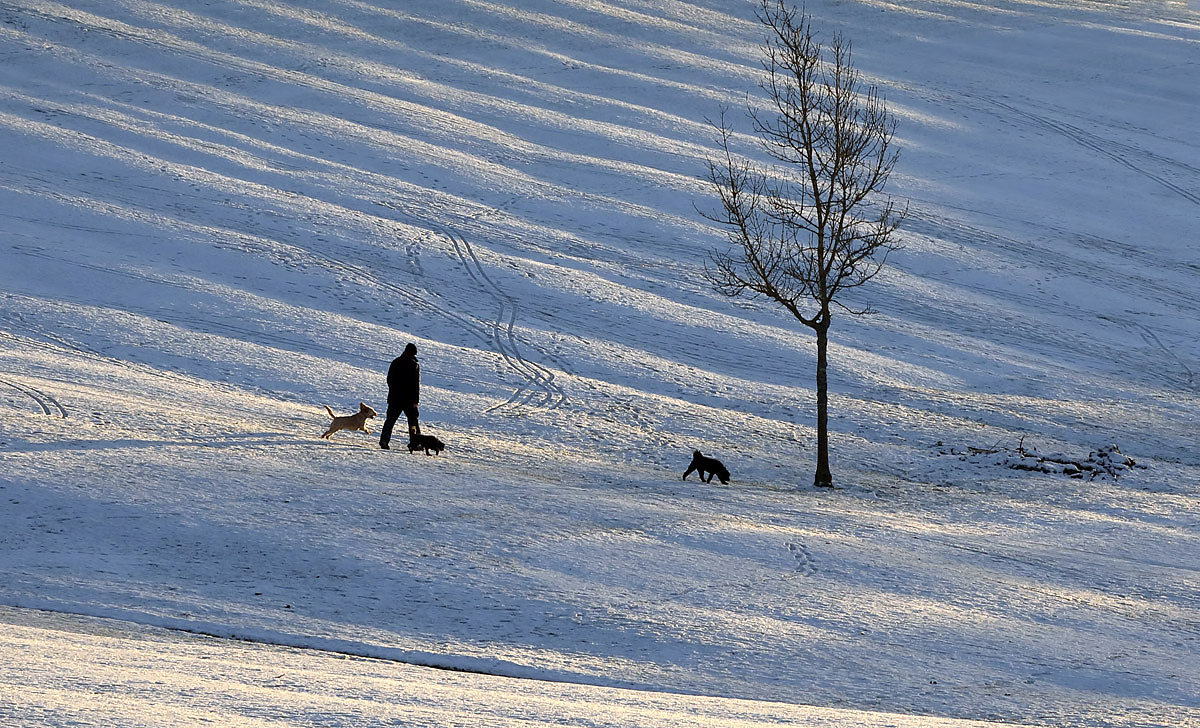
Photo: Walking the dogs on Ladhope Golf Course – geograph.org.uk – 7364896, by Walter Baxter, CC BY-SA 2.0 (Wikimedia Commons)